Of course I will watch the dog but I do not know what to say to it. Although I cannot have the truth I am sure there was a transgression. While I am improving I fear this will not look like progress to you. Maybe if it stays the same it will seem easier like at the start. Please remember when the party ends it must become another thing. We hit our strides at different points along the road today I did first. If I abide by my decision I may not be held for a while. Tomorrow will present some options and I trust I will be different. It is a month of ceremonial endings followed by the new. The missing started long before and still I hang onto all the stuff. Today we can run forever on any terrain on the new dirt. Recently I committed to learning discipline and it helps me. Eventually after your barking you climb the hill with conviction. This is my home and it is where I would like to raise a child or two. Despite our miscommunication I strive to speak to dogs like kids. People name the things they love and what happens after is up to them. Bicycles and people crash we all move in a loop like this jagged.
Everyone gets all crazy when the sun comes out. Moths are like us. People forget how to walk, they are screaming I am smiling at them, I am robbing cvs.
Everyone has found a baby and the baby has more sense. Blinding ourselves in sublime light reminds us of when we knew god. Babies just know it as light. Spirited but weak, they move toward the hot thing which is the point. Every living thing is doing something weird right now in the park for we have the cosmic excuse. Warm sky gives us license to look up as we haven’t in a season. It tricks our sad faces into burning and into recognition. And I have to get out of here, I have to get out of here, there is no other way!
As he gingerly navigated our vehicle along the windy, highway-facing edge of Flushing Meadows—Corona Park, my colleague noted the incongruity of the landscape before us. “It’s the Robert Moses special,” Jack said as he rounded a curve to continue searching for his team. The path was matted with runoff from the elevated road after a recent spell of rain. The spillage of vehicular waste, soil, and water had hewn this walkway over the years, yet it still received a fair amount of careful foot traffic on an unseasonably cold Tuesday morning. Thoroughfares bind this green expanse on all sides but its northern stretch, which sits on the shore of Flushing Bay. We wondered how anyone could get over here without driving a car or boat, or without flying into nearby LaGuardia Airport. Many of these 897 acres of public green space were remarkably difficult for the walking public to access.
Former New York City Parks Commissioner Robert Moses conceived of the park in tandem with its adjacent highway infrastructure. The land upon which we stood had been used as a collection site for household coal ash and detritus swept from Brooklyn streets at the start of the twentieth century (NYC Parks, “Flushing Meadows–Corona Park”). The city began to transform the site when it was selected to host the 1939 World’s Fair, rehabilitating disused meadows and repurposing leveled ash mounds for the construction of major roads. Flushing Meadows and Grand Central Parkway emerged through an ambitious planning process, offering Queens a large recreational landscape fortified by eight lanes of automobile congestion (NYC Parks, “Grand Central Parkway”).
Despite its perceived inaccessibility, the park swelled with activity as the morning stretched over it. Pedestrians and cyclists who made it to the park’s eastern periphery thanked my colleagues as they passed. The team trimmed the wind-whipped weeds and restored the lawns around the park, helping to maintain the beauty that brings people back each day. Their tools joined the drone of cars and the hum of descending planes in a peculiar chorus. The breeze dispersed plant matter and the strong smell of gasoline. Residents hopped and swerved around us, enacting the delicate but certain choreography of their daily routines on this terrain.
This was a version of New York. You get to know a city through its recreational spaces. People come because they need to. They find a way. The park has its own history, but is tied to many others. Like much of this city, it was once something else. It was inhabited by Indigenous Algonquian groups, who were displaced by European settlers in the 1600s (City of New York 2001, 5). The area was built and rebuilt. More people were forced to leave their homes to build the park and the roads that rip through it (Steinberg 2015, 218). The park was designed to be used, and its uses have changed with the years. The park is always becoming new. It is meaningful to people. While this highly detached narrative seems familiar, the park has its own life. The place is made and remade by those who flock to it. It has a specific, complex history, but its most significant events may have little bearing on its current relationships with devoted visitors. It is made in practice, activated through a kind of knowing that mirrors Jeanne Favret-Saada’s research on witchcraft in the Bocage of Western France (Favret-Saada 1980, 11). There is power in what we know and how we speak about this place.
Among the multifarious functions of this vast complex is the preservation of the city’s memory. The park is home to the New York Hall of Science, the Queens Wildlife Conservation Center, Queens Zoo, Queens Theatre, the Queens Museum, Citi Field, and the Billie Jean King National Tennis Center. Its large, bizarre central monuments are important to the city’s visual identity. The Unisphere and the New York State Pavilion were constructed for the 1964 World’s Fair, immortalizing the event in steel and concrete. The Queens Museum’s Panorama of the City of New York was also devised for the fair, but the beloved model has been updated to reflect changes to the built environment (Queens Museum). It is a physical structure, but it is not fixed, helping visitors make sense of the past and the shifting present. Rather than presenting a complete replica, this representation invites us to consider the immensity of our city.
Our buildings can shape an image of New York, but the city’s wrought silhouette looks different depending on where you stand. When perched on the highest natural point above sea level in Manhattan, the city looks like a series of six-story pre-war apartment buildings that have since dwarfed this unremarkable splash of schist. Two hours away on the A train, Manhattan’s grand pillars are reduced to tacks on the horizon west of Rockaway Beach. You can view the skyline woven into souvenir shirts when looking east from Hoboken, New Jersey. Marilyn Strathern identifies and critiques the concept of perspective that took hold in European Renaissance art, arguing that it is unable to capture the fluidity of exchange that is central to Melanesian dance displays (Strathern 2015, 97). Being able to accept perspective as something that is multiple and moveable can broaden our understanding of self and other. Every way we look at New York is different, and every way is true.
Looking is participatory; we are always simultaneously performing and observing the city. The city can be a mess of buildings, but it must also constitute the things around them and under them and the people everywhere. It is an idea that we make. Structures buttress this idea so well that they can be mistaken for the city itself. Buildings are substantive, and perhaps New York’s spectacular assortment of towers legitimates the city. It communicates a capacity to build, if nothing else. When afforded the rare, often unexpected opportunity to admire the built environment, I experience the same muted veneration I feel when I notice an old painted sign where an awning was removed or catch a glimpse of a full moon through the yellowing film on a bus window. I have spent every year of my life looking upon the city’s architecture with an awe that expands when I am with someone who has never seen it before. It is an awe produced in context.
I love New York. I respect it and I fear it. The city and I perform our curiosity together. I am in relation to what I think the city is, and we are growing up. Renato Rosaldo’s meditations on emotional force provide a frame to assess the intensity and inconsistency of the many affective associations one might forge with this place. In his work with the Ilongot people of northern Luzon, Rosaldo could not comprehend the grief-informed rage that brought his interlocutors to perform the practice of headhunting (Rosaldo 2014, 117). After his wife, anthropologist Michelle Zimbalist Rosaldo, died during a research trip to the Philippines in 1981, he began to grasp the descriptive power of emotional force (122). To accept headhunting as it was, he needed to abandon a learned attachment to reason. His collaborators spoke plainly about the loss that inspired their urge to hunt others and collect their heads. He appreciated the ineffable potentiality of upheaval through his own experience of loss, challenging the anthropological discipline to accept the potency of great feeling which might come at any time and get into everything.
Perhaps it is this feeling that inspired me to investigate the park. Until April of 2025, my grandfather lived by one of its poorly-lit entrances. The Grand Central Parkway separated him from the activity of the baseball stadium and the nearest subway station. Twenty-one years ago, he lost his wife in a car accident that severely injured him and reconfigured the life he knew. I was very close to my grandparents, and I spent most weekends in Elmhurst, Queens before they left for their first vacation in a long time. The event occurred in Hilo, Hawaii. I had grieved unexpected deaths before this, but I had never been so aware and so angry. My grandfather moved in with my family during his recovery. Then, he moved into a one-bedroom apartment in Corona. He kept every piece of the life he shared with my grandmother. A month ago, I brought two suitcases packed with their silverware and framed photographs to Manila. After living beside the strange, friendly expanse of Flushing Meadows for two decades, he decided to return home.
I had only known my grandfather as a resident of Queens. His presence saturated my mental associations to this neighborhood and to New York. It was a place of many sounds, with an abundance of Filipino restaurants, and it was where my family grieved. It was far from Washington Heights, where I grew up. However, I loved the car ride to my grandfather’s house over Randalls Island and the Robert F. Kennedy Bridge. Traversing a moderate distance made the journey feel special and new. Manila is much further away. This was not the first time I had wandered the park since my grandfather left the neighborhood, but there I could sense his absence. Rosaldo confronts a tendency in symbolic anthropology toward the categorization of events for the purpose of their study. However, he finds that in binding a moment to become legible as a text, one obfuscates “the untidiness of everyday life” (126). The fabrication of a geography of New York is an exercise in accepting the personal, the emotional, and the inexact. The map fills with events that fall into one another, calling them back and forth through time.
If the city cannot lie merely in buildings and bounded truths, we can turn to writers who can provide a more pliable scaffolding for the study of New York. In the first chapter of Distinction: A Social Critique of the Judgement of Taste, Pierre Bourdieu presents an approach to the study of society through its various fields (Bourdieu 1986, 4). The field is a distinct social area in which people express their proximity to cultural, economic, social, and symbolic capital (5). He investigates the concept of taste, dissecting the perceived ineffability that had long constrained its analytical apprehension. He observes that one’s access to forms of capital determines one’s concept of taste, which can illuminate and reproduce class distinctions (4). Surveying French residents in 1963 and 1967-1968, Bourdieu learned that their preferences in areas like art and music communicated specific competences to receive legitimate cultural works (8). He writes: “Tastes (i.e., manifested preferences) are the practical affirmation of an inevitable difference. It is no accident that, when they have to be justified, they are asserted purely negatively, by the refusal of other tastes. In matters of taste, more than anywhere else, all determination is negation; and tastes are perhaps first and foremost distastes…” (49). The idea of taste can be best understood in opposition to what it is not, justifying the continued fracturing between those whose tastes do not align. It is a tool that reproduces both social desires and divisions. He continues: “…each taste feels itself to be natural—and so it almost is, being a habitus—which amounts to rejecting others as unnatural and therefore vicious. Aesthetic intolerance can be terribly violent. Aversion to different life-styles is perhaps one of the strongest barriers between the classes; class endogamy is evidence of this.” Bourdieu offers a means of interpreting the structures that guide our social world and their attendant cruelties. Social barriers pervade the city. Even the ones that resist observation mold the urban social order. What we think maps itself onto the spaces we occupy and shapes our relationships with one another.
New York provides a fruitful foundation for social exchange. Queens is home to 2.3 million residents, half of whom were born internationally and half of whom were born in New York state (NYU Furman Center). It is extremely diverse, and there is no ethnic majority in the borough. In a city of immense cultural difference, it can be challenging to find a concept like taste that might reveal the nuances of social life in New York. Arjun Appadurai develops a set of interdependent parameters to support the study of global systems in his 1990 text “Disjuncture and Difference in the Global Cultural Economy.” Applying Gilles Deleuze and Félix Guattari’s concept of deterritorialization to his expansion of Benedict Anderson’s imagined communities, Appadurai asks us to consider relationality through the lens of disjuncture. Appadurai assesses the economic, cultural, and political disjunctures that comprise our imagined worlds across five planes, which offer us some reference points in a frenzied geography. Ethnoscapes, mediascapes, technoscapes, financescapes, and ideoscapes are fluid, “perspectival constructs,” which actors shape and metabolize in different ways (Appadurai 2016, 549). His description of these configurations of peoples, technologies, and transfers of capital, images, and ideologies aligns with the rhizomatic perspective Strathern studied in Melanesia, positioning these flows together and apart, everywhere and nowhere. This, of course, makes them difficult to pin down. Perhaps that is the point. If the patterns of exchange are fluid, our theoretical frame must be fluid as well.
His discussion of deterritorialization can help us accommodate fragmented narratives of the globalized city. He writes: “It is in the fertile ground of deterritorialization, in which money, commodities, and persons are involved in ceaselessly chasing each other around the world, that the mediascapes and ideoscapes of the modern world find their fractured and fragmented counterpart” (552). He evokes Mira Nair’s 1985 film India Cabaret to elucidate the complex loops of this fracturing, as young women seek employment as cabaret dancers and sex workers in Bombay based on the fictionalized roles they had seen portrayed in Hindi films. Layers of relational displacement intersect in this constructed practice, particularly as the women work among men who may lack the opportunities in their own social worlds to elaborate their desires. All actors in this exchange are performing an adopted, exaggerated role, which gains substance through the act of performance. When we tell ourselves stories, we begin to believe they are true. A city is a conglomeration of constructed truths.
New York is in the throes of a fraught mayoral race, whose key actors must tell the city’s story in a way that resonates most with its constituency (Fitzsimmons and King 2025). Nair’s son, Zohran Mamdani, is a young, progressive New York State assemblyman who has joined a crowded field of Democratic candidates. Other notable figures in the Democratic primary race include City Council speaker Adrienne Adams, former governor Andrew Cuomo, comptroller Brad Lander, and activist Paperboy Love Prince. Mayor Eric Adams recently announced his retreat from the political party, campaigning as an independent for the November election. This news followed a judge’s dismissal of the incumbent’s five-count federal indictment on corruption charges, which involved the Trump administration’s intervention on the mayor’s behalf. The public denaturation of the city’s municipal leadership demonstrates the fundamental inconsistency in the top-down vision of New York. The cohesive story is seductive, but is dreadfully incomplete. New Yorkers have to choose the story that makes the most sense to them. Simultaneously, New Yorkers need to remain involved in the collaborative project of imagining the city. I suppose we have no choice.
It was difficult to find a thread through the histories of New York. There are several names, spots, and eras that come up over and over, but they are connected to so many other things. The web grew. To pause this futile excavation, I attended a screening at the Anthology Film Archives last week. My dear childhood friend Daniella Brito curated film screenings, performances, and discussions that will take place over the course of the summer. For the first installment in their Imaging Improvisation series, Daniella selected two films from The Kitchen’s archive. In one shaky video, Bronx hip hop group the Funky 4 + 1 performed their song “That’s the Joint” twice during the 1980 event Dubbed in Glamour (The Kitchen 2014). In the next clip, Fab 5 Freddy emceed the 1981 “Graffiti Rock” show, which brought crews of breakers from New York’s streets to an institutional stage (Anderson 1981). I sat beside Daniella’s father, and we laughed and cheered with the improvised quirks on the screen. This was the environment in which he was raised. I was transported to a time I had not experienced with someone who knew it well. Also, the movements of the camera for these single-shot films mimicked the way an audience member would have watched these shows. We were all in the room, and we were all moved to respond.
This was another New York. It was one my father cherished. He had a fondness for the ambient danger he sensed around him. By the time my mother arrived in the early 1990s, the city had changed. I was born into a different landscape. Anyone I ask has their own interpretation of the story of the city, but they all note its constant movement. It is impossible to identify what is happening until it has happened. Even then, the record is incomplete. Narratives are filled when we speak about the past. My version of New York persists in every person I witness on the subway, in what I catch on public access television, in the things my parents have told me, and in anything I have not come across yet. Every day I learn a bit more, but I am glad I cannot know everything. The city exists in how it changes and how we talk about it. We must accept its changing, and that gives us something to talk about.
Bibliography
Anderson, Jack. “DANCE: ‘BREAKING’ INDOORS.” The New York Times, October 6, 1981, sec. C.
Appadurai, Arjun. “Disjuncture and Difference in the Global Cultural Economy.” Essay. In Readings for a History of Anthropological Theory, 5th ed., 547–55. Toronto, ON: University of Toronto Press, 2016.
Bourdieu, Pierre. Distinction: A Social Critique of the Judgement of Taste. Oxfordshire: Taylor & Francis Group, 1986.
City of New York, Landmarks Preservation Commission. Stage 1A Archaeological Assessment. Shea Stadium Redevelopment Flushing Meadows Corona Park. Block 1787, Queens, New York. Historical Perspectives, Inc. CEQR No. 02DPR001Q. New York, NY: NYC.gov, 2001.
Favret-Saada, Jeanne. Deadly Words: Witchcraft in the Bocage. Cambridge: Cambridge University Press, 1980.
Rosaldo, Renato. The Day of Shelly’s Death: The Poetry and Ethnography of Grief. Durham, NC: Duke University Press, 2014.
Steinberg, Theodore. Gotham Unbound: The Ecological History of Greater New York. New York: Simon and Schuster, 2015. ISBN 978-1-4767-4128-4.
Strathern, Marilyn. Learning to see in Melanesia: Four lectures given in the Department of Social Anthropology, Cambridge University, 1993-2008. Chicago, IL: Hau Books, 2015.
“Keep the door partially open. I’m nosy.” –Ann Jennings
Prologue
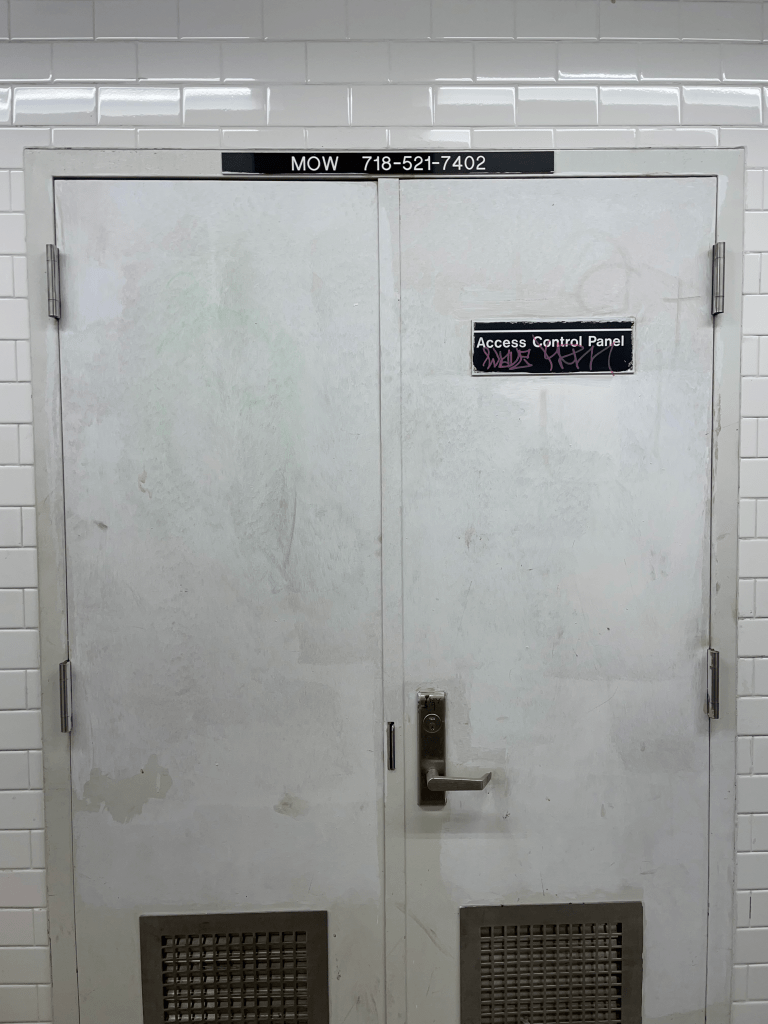
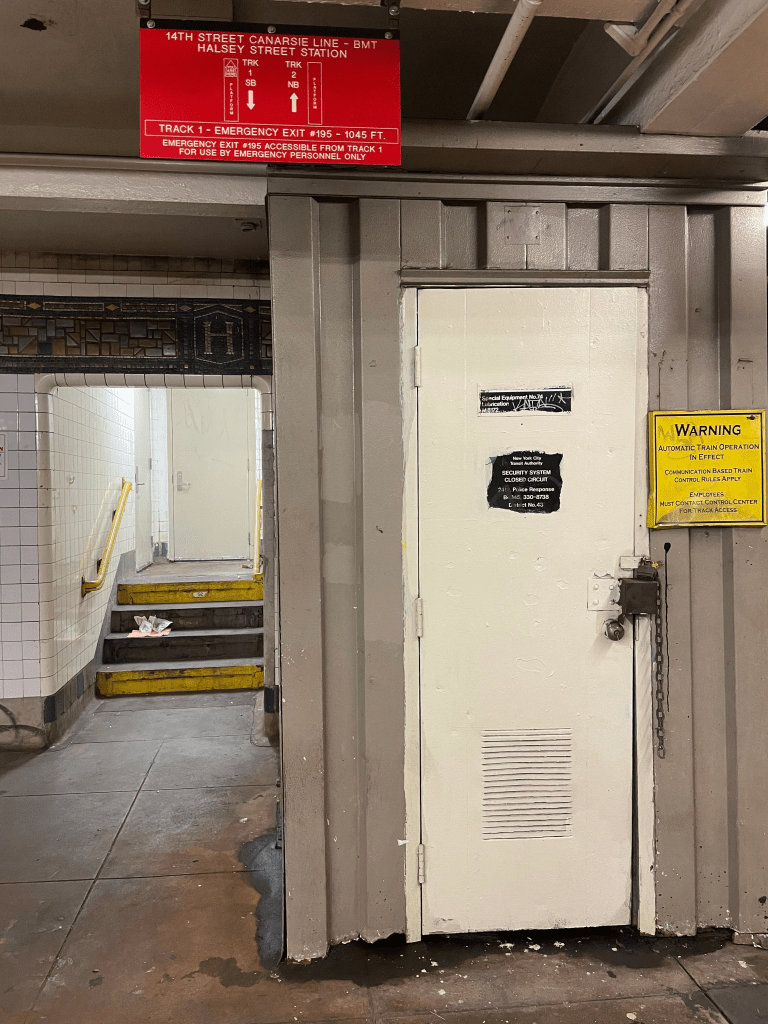
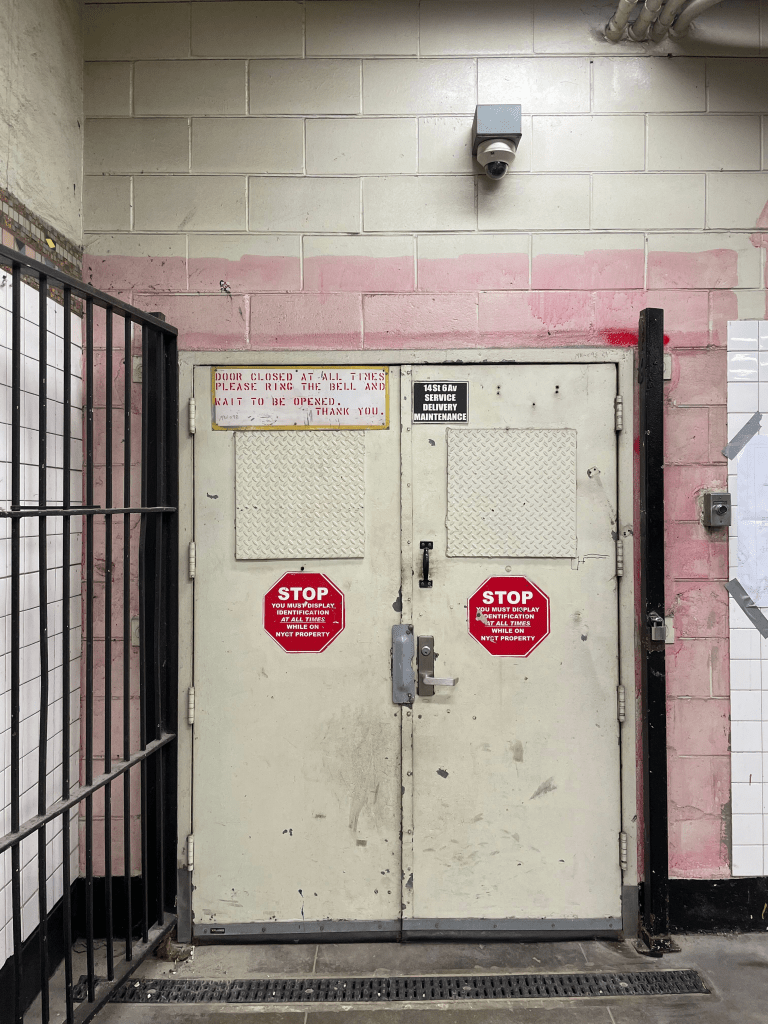
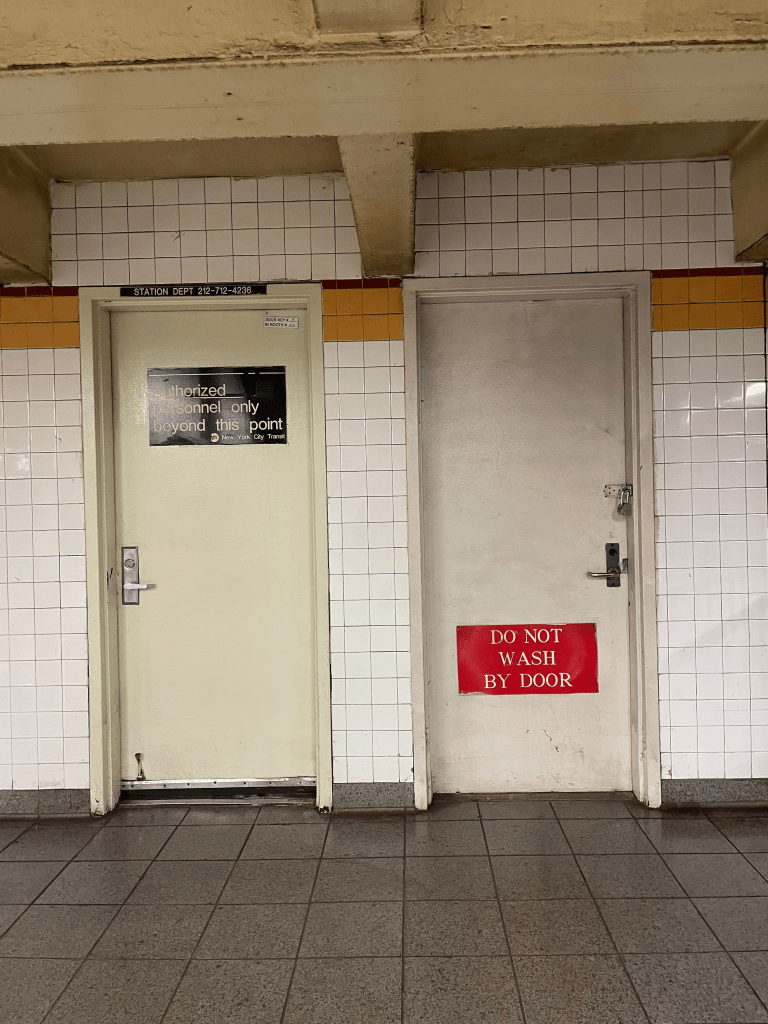
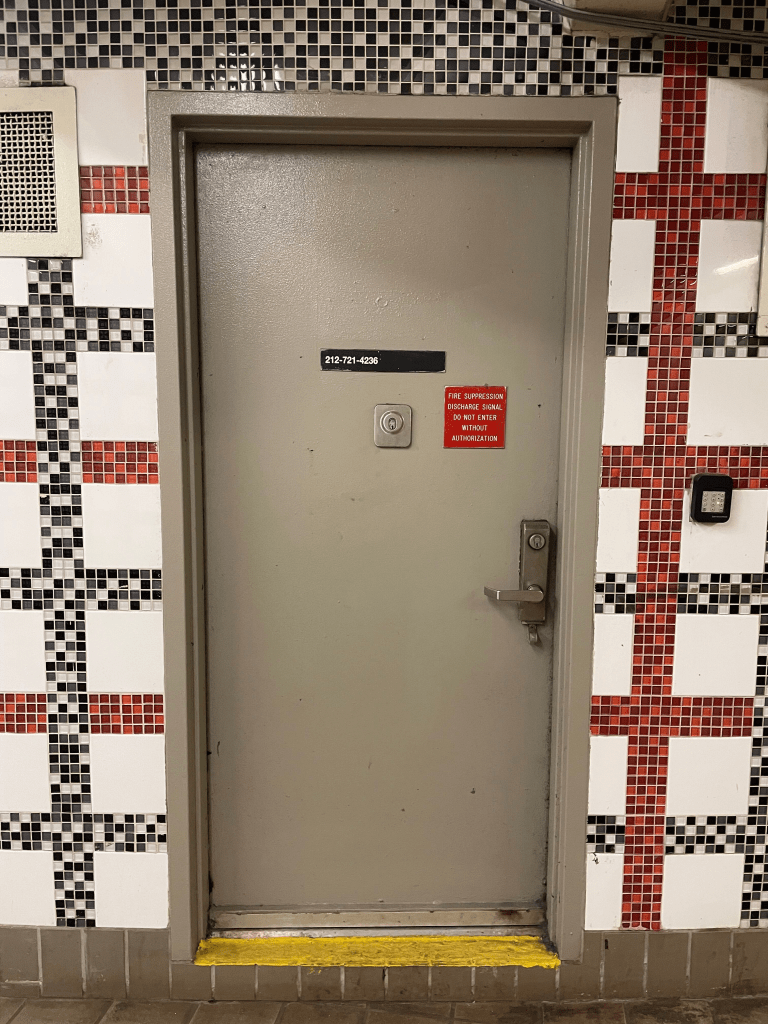
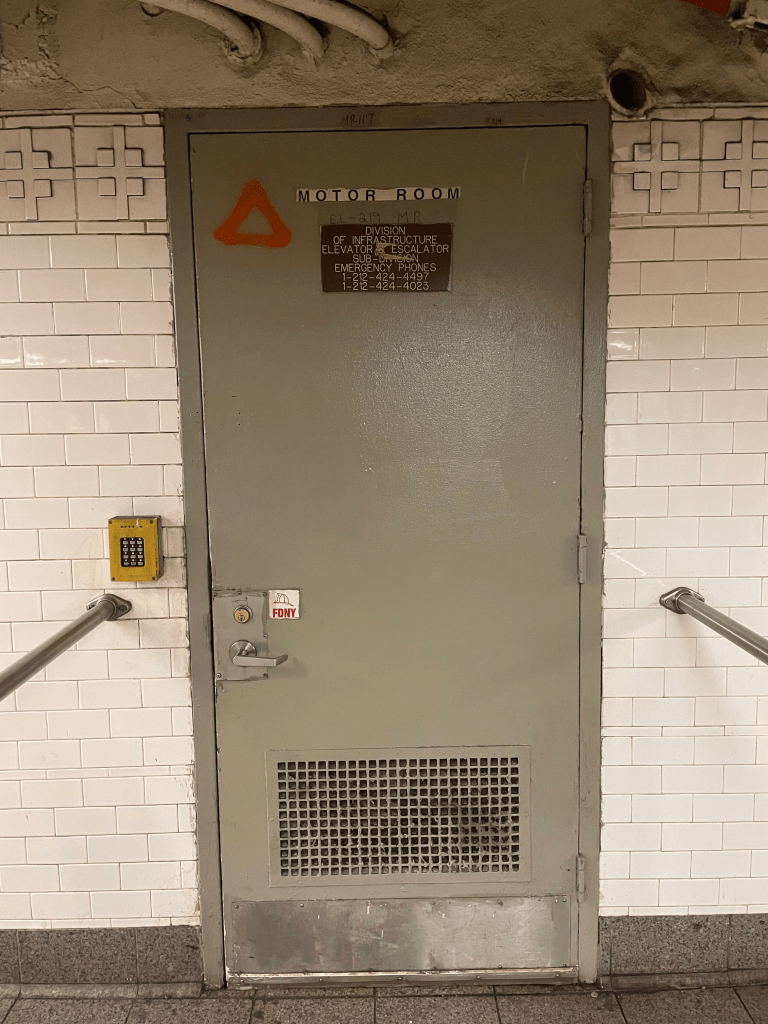
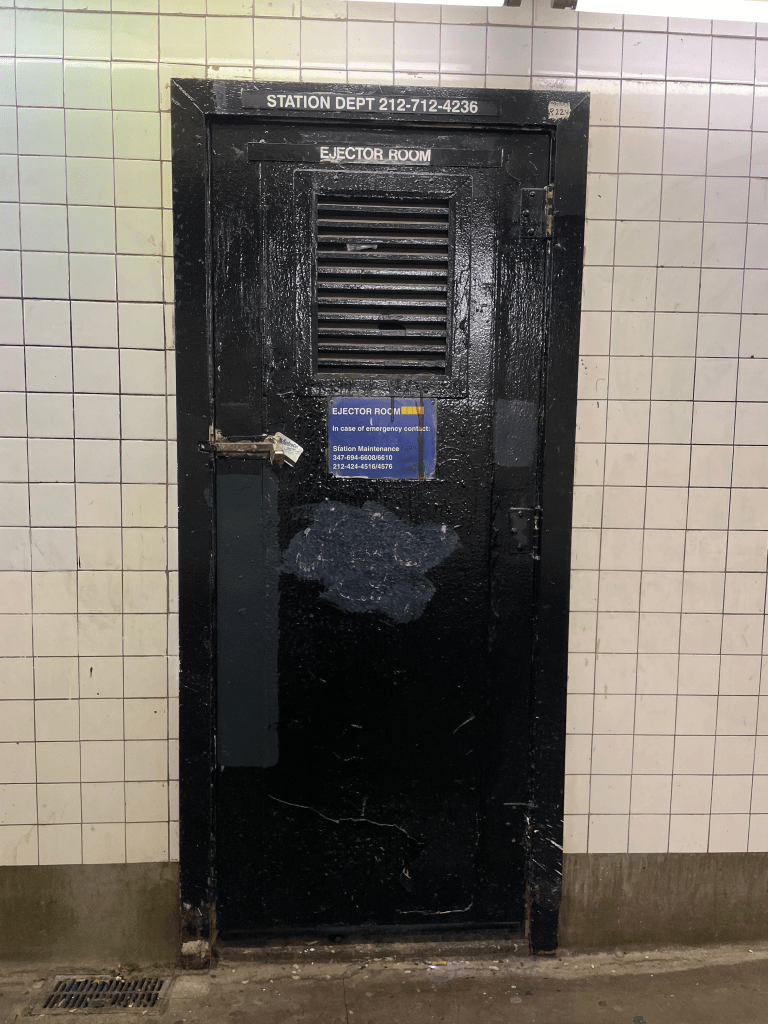
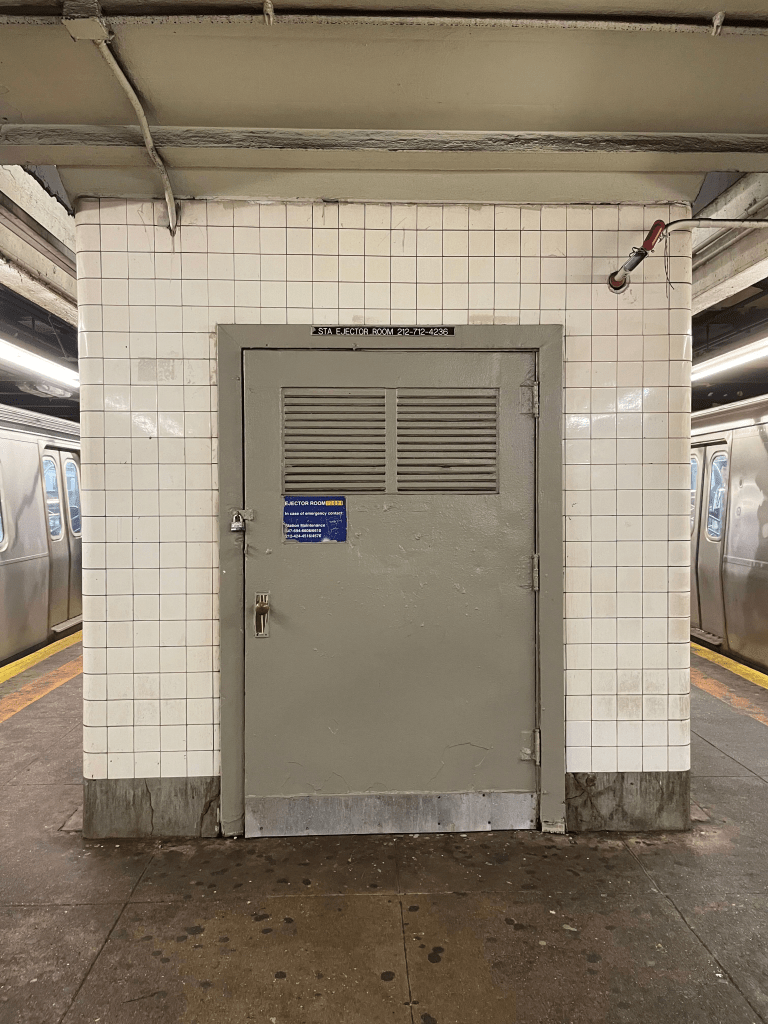
These doors trace the years and can be easy to miss. Once I noticed the first odd door, I began looking everywhere. I appreciate the transit system’s insistence on naming. While the rooms within each subway station are obscured from public view, their functions are duly announced in whichever font was standard at the time of their construction. They denote place or something real. It is a twisted courtesy. Next time, pause before the quiet gift of an inscription. Do its words mean anything to you? I will keep looking. This will never end.
Access Control Panel. 191 St Station. March 15, 2023
Lubrication
69 Track Lubrication. Lorimer St Station. March 1, 2023
Lube Room. 96 St Station. February 5, 2023
CAT Team 12 Track Lubrication in Case of Emergency. 15 St-Prospect Park Station. February 24, 2024
Special Equipment No.74 Lubrication Warning. Halsey St Station. November 3, 2023
Intensity
Doors Must Be Locked at All Times No Smoking. W 4 St-Washington Square Station. November 29, 2023
Stop. W 4 St-Washington Square Station. November 29, 2023
Wait To Be Opened. 14 St/6 Av Station. September 26, 2023
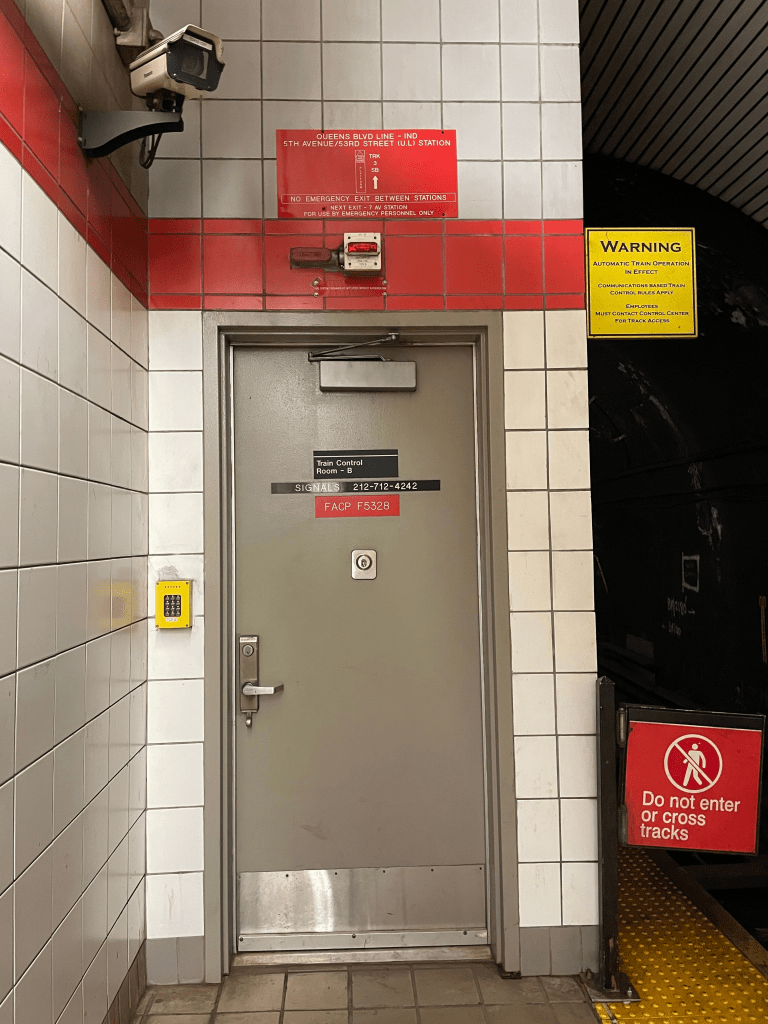
Danger High Voltage. 5 Av-53 St Station. November 20, 2023
Do not wash
Please. 34 St-Herald Square Station. February 16, 2023
Do Not Wash by Door. 14 St/8 Av Station. November 3, 2023
Learning Center Central. 14 St/8 Av Station. December 15, 2023
Esoteric
212-721-4236. 5 Av-53 St Station. July 19, 2023
Strobe Light. Grand Central Terminal. June 28, 2023
Tower
Tower Normal. Brooklyn Bridge-City Hall Station. November 11, 2023
Tower Ext. Delancey St-Essex St Station. February 26, 2024
Move
Motor Room. 14 St-Union Square Station. February 28, 2024
Third Rail. 14 St-Union Square Station. January 13, 2024
Ejector
Ejector Room. Fulton St Station. November 5, 2023
Structure. Canal St Station. December 24, 2023
Wide Ejector. Hoyt-Schermerhorn Sts Station. April 16, 2023.
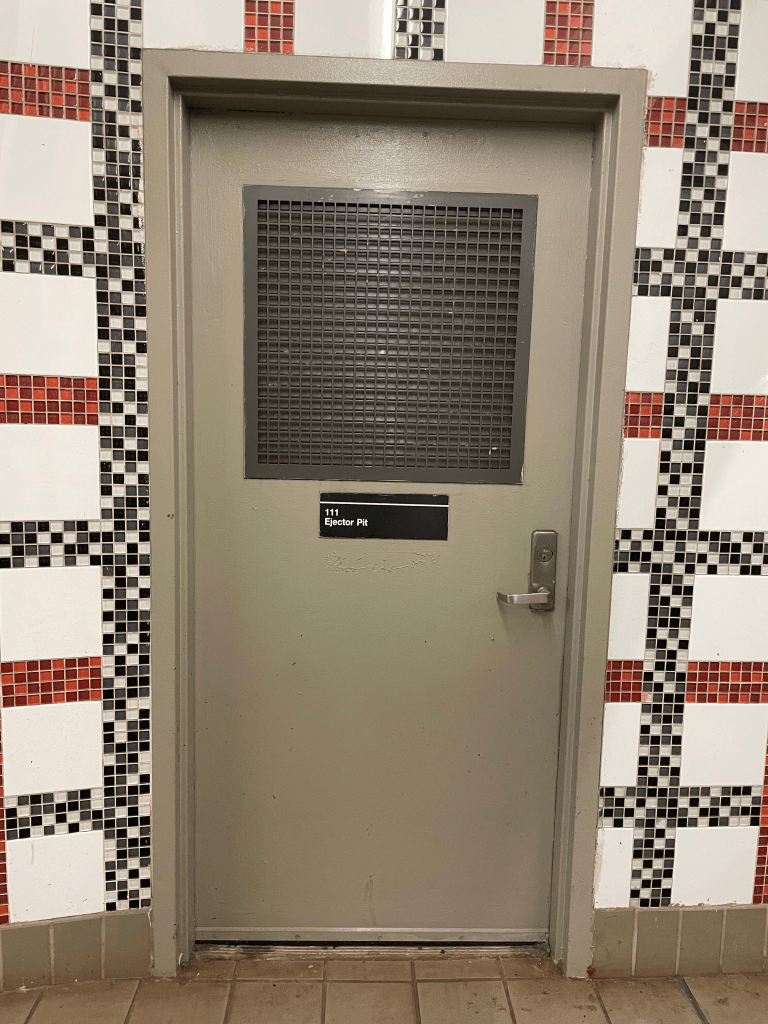
Ejector Pit. 5 Av-53 St Station. July 24, 2023
Storage
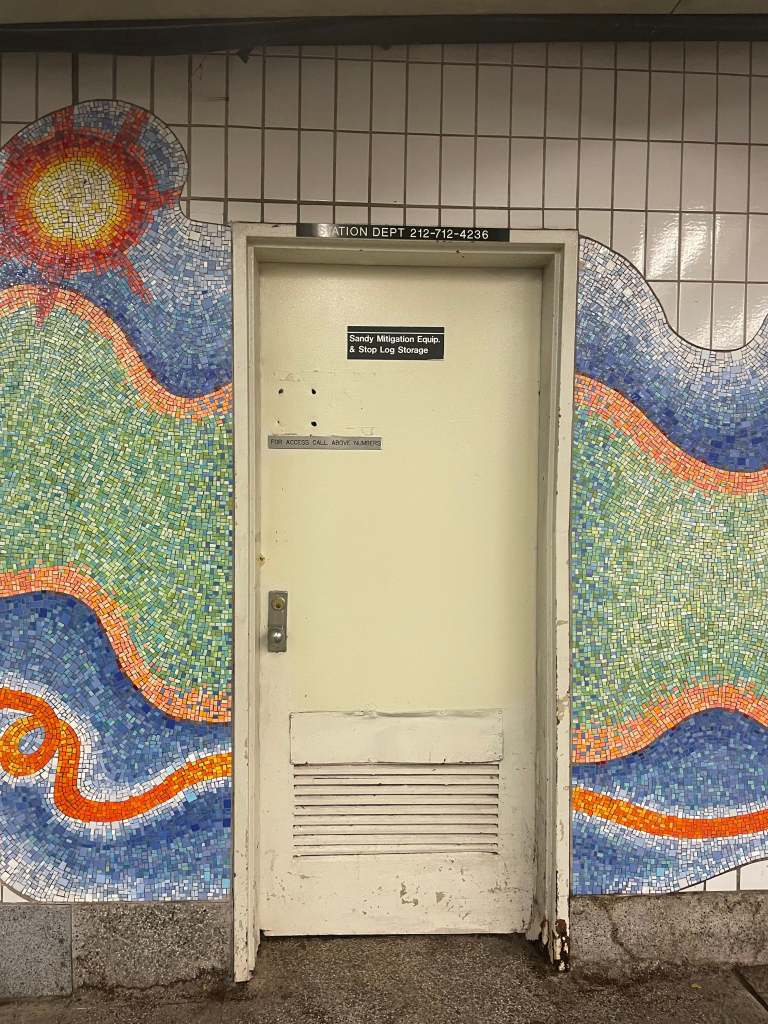
Sandy Mitigation. Court Square Station. July 13, 2023
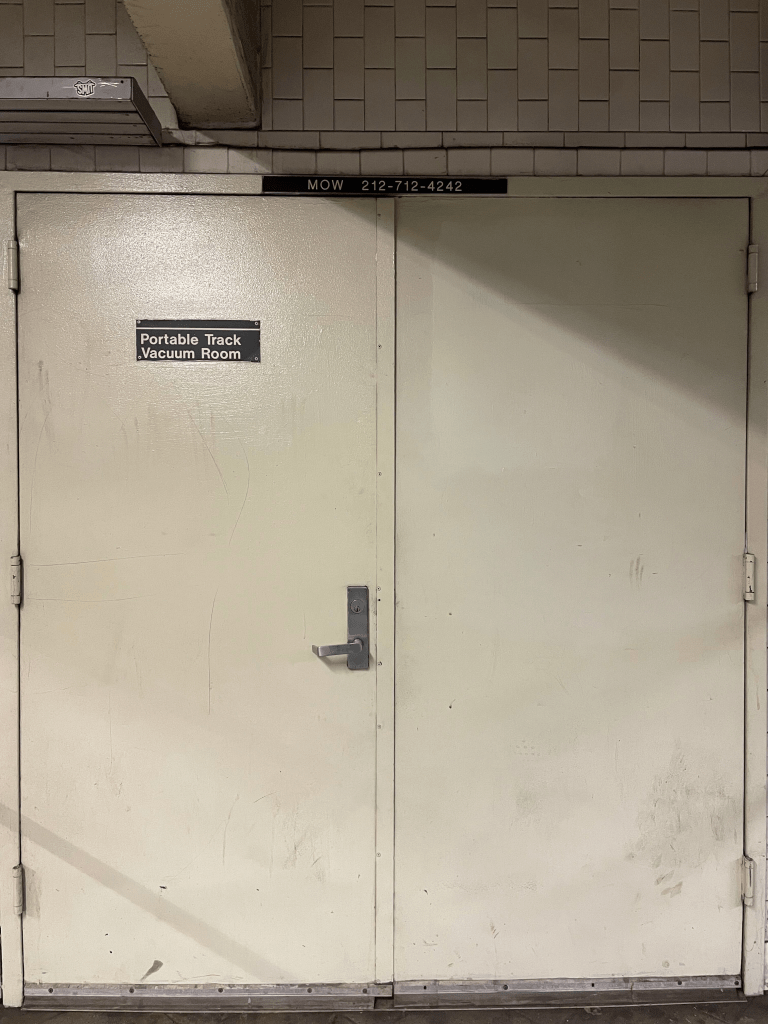
Portable Track Vacuum. 59 St-Columbus Circle Station. February 3, 2023
Electro-Mechanical. Court Square Station. July 13, 2023
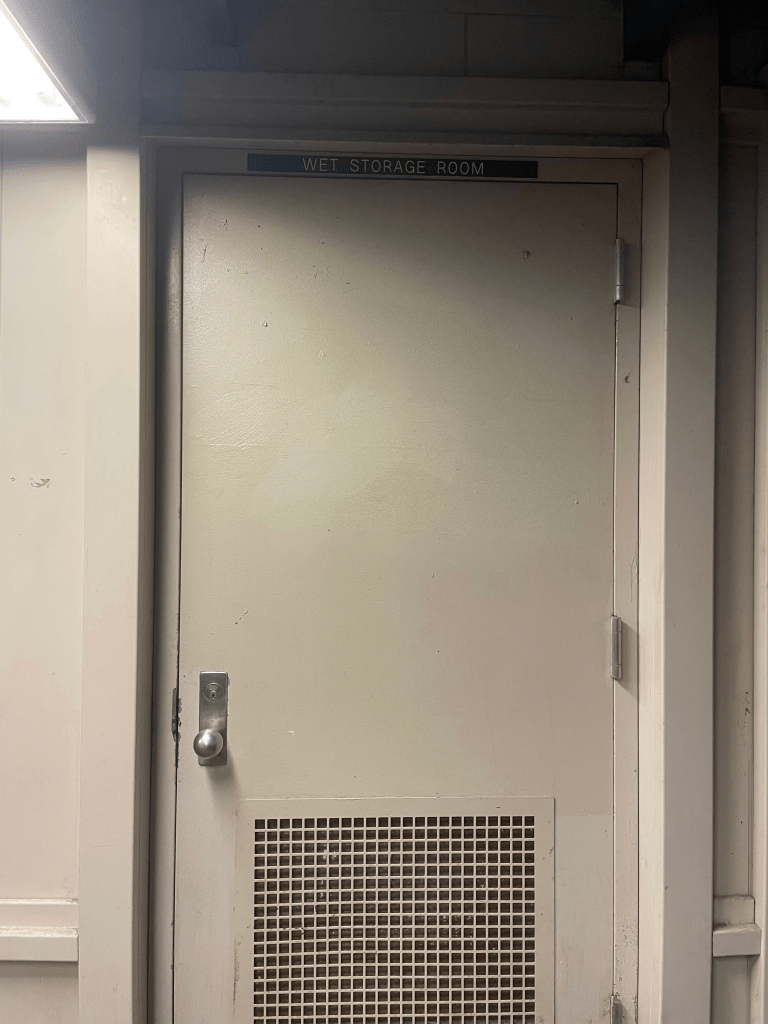
Wet Storage Room. Knickerbocker Av Station. February 6, 2024
Chemicals
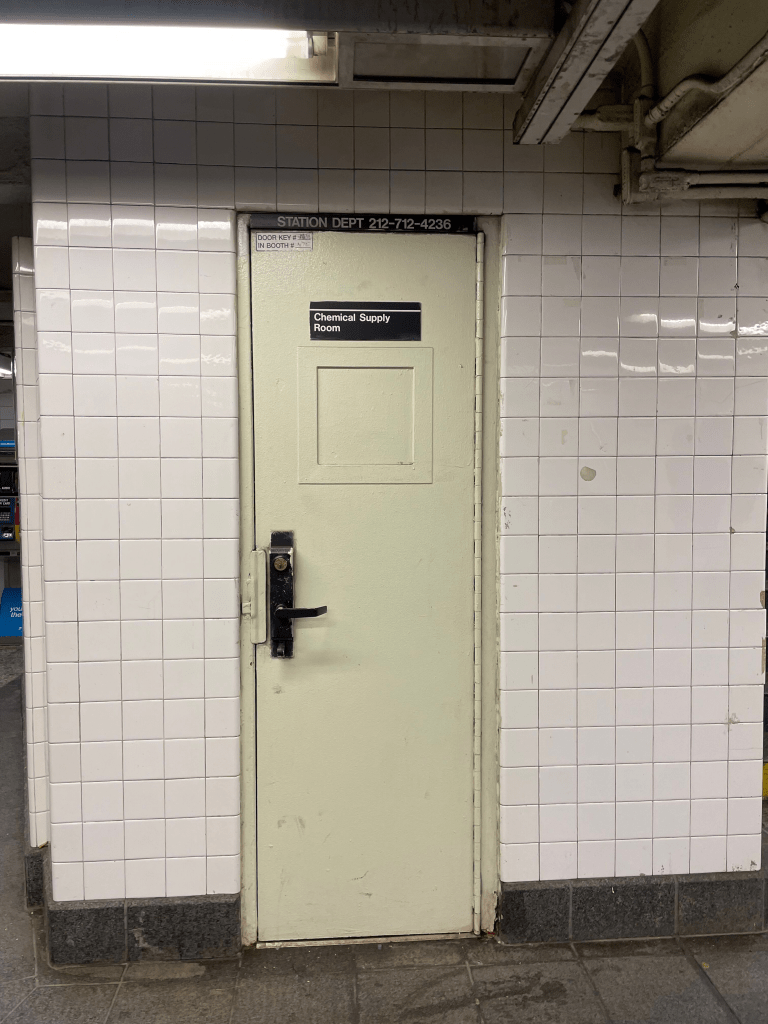
Chemical Supply Room. 34 St-Penn Station. November 15, 2023
Chemical Supply Room & Loose Chain. W 4 St-Washington Square Station. November 29, 2023
Lighting
Lighting Equipment Room Normal. 125 St Station. January 21, 2024
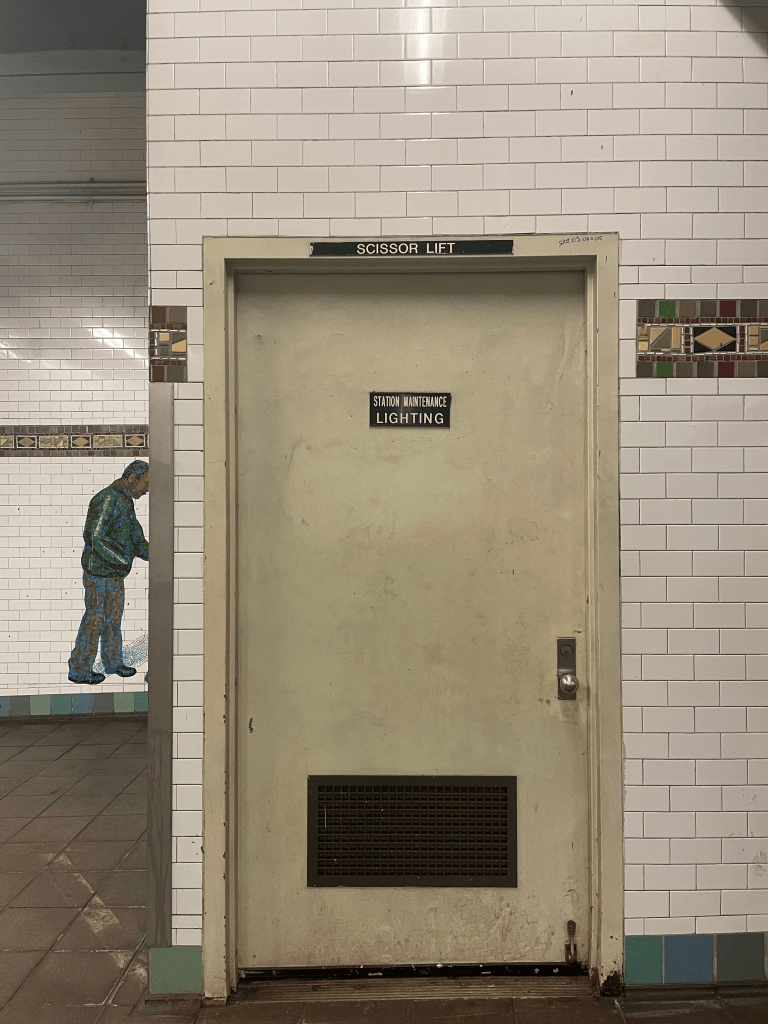
Scissor Lift. Times Square-42 St Station. February 7, 2023
Lighting Department Zone. Hoyt-Schermerhorn Sts Station. April 22, 2023
Lighting. Church Av Station. November 29, 2023
Signals
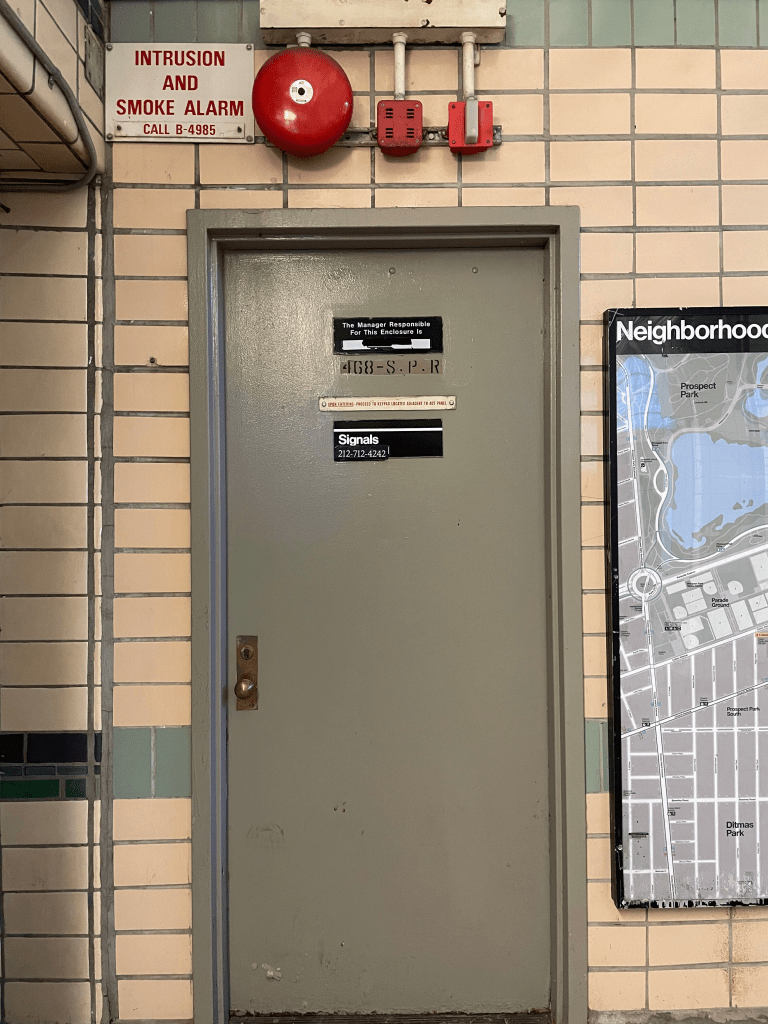
The Manager Responsible for this Enclosure Is. Church Av Station. November 29, 2023
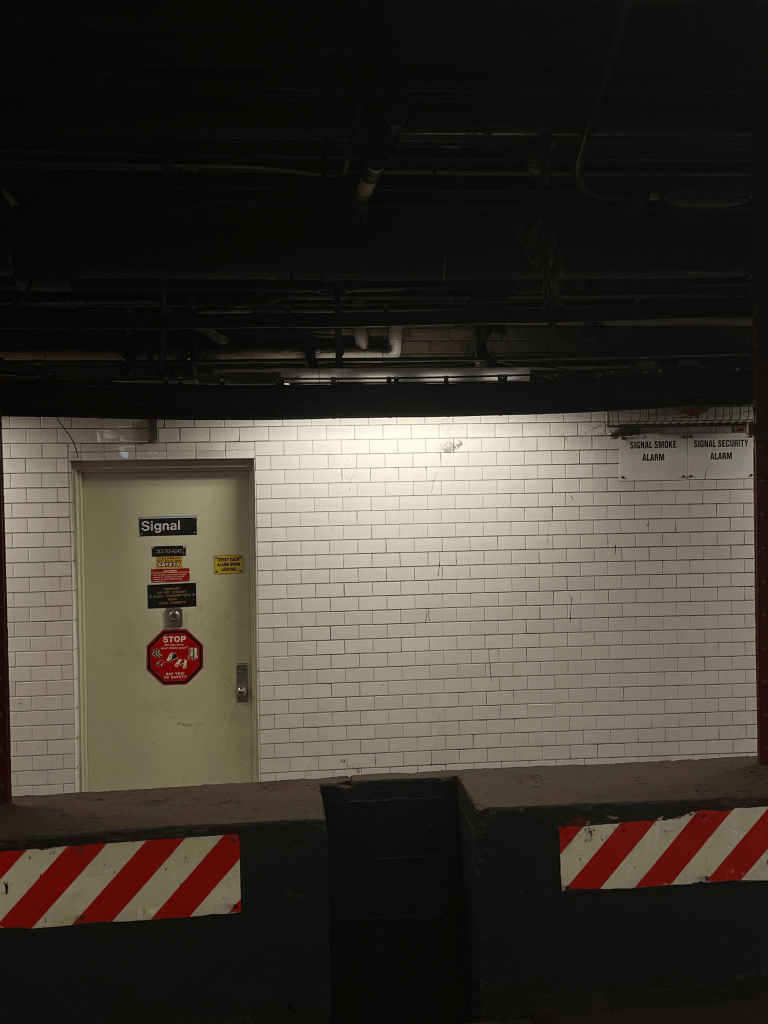
Reset Each Alarm When Leaving. Delancey St-Essex St Station. February 26, 2024.
Signals. 14 St/8 Av Station. December 15, 2023
Train Control Room – B. 5 Av-53 St Station. December 18, 2023
Little
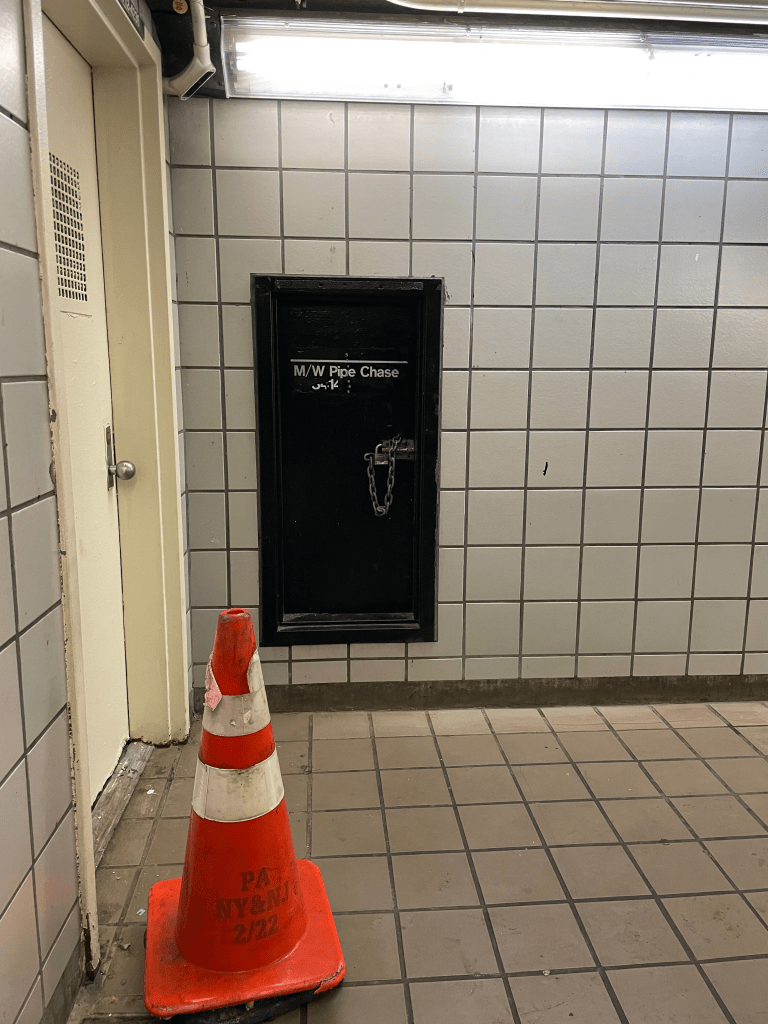
Pipe Chase & Pylon. 42 St-Port Authority Bus Terminal. June 9, 2023
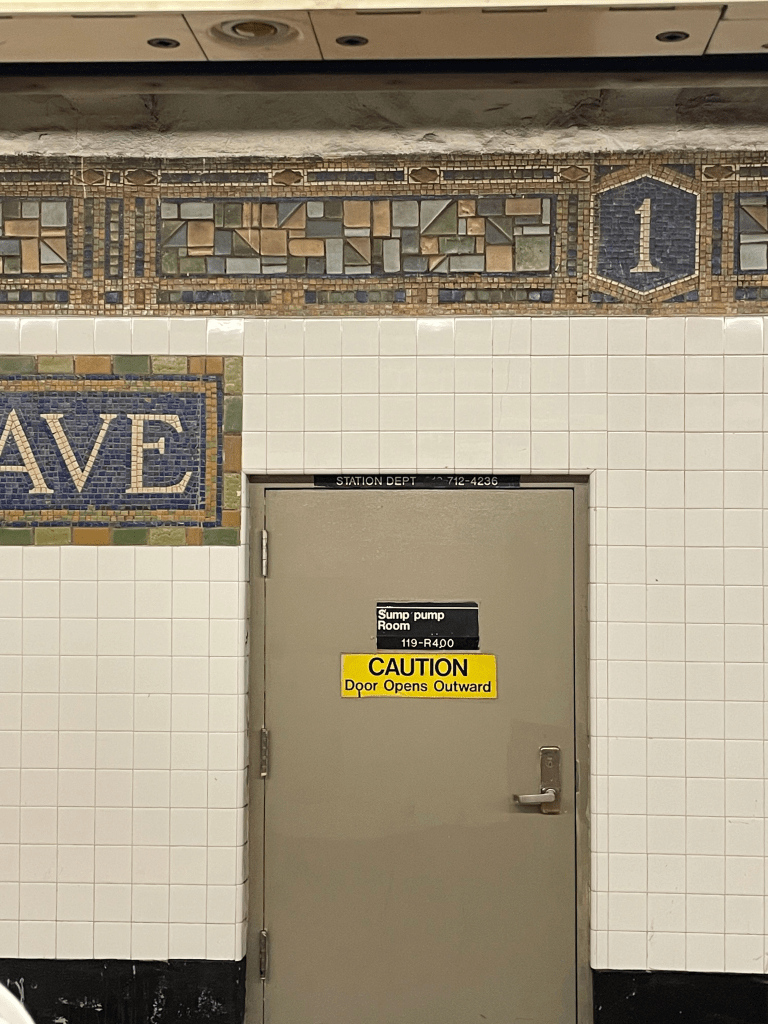
Sump Pump. 1 Av Station. July 17, 2023
Relief
Employee Lunch/Locker Room. 190 St Station. April 17, 2023
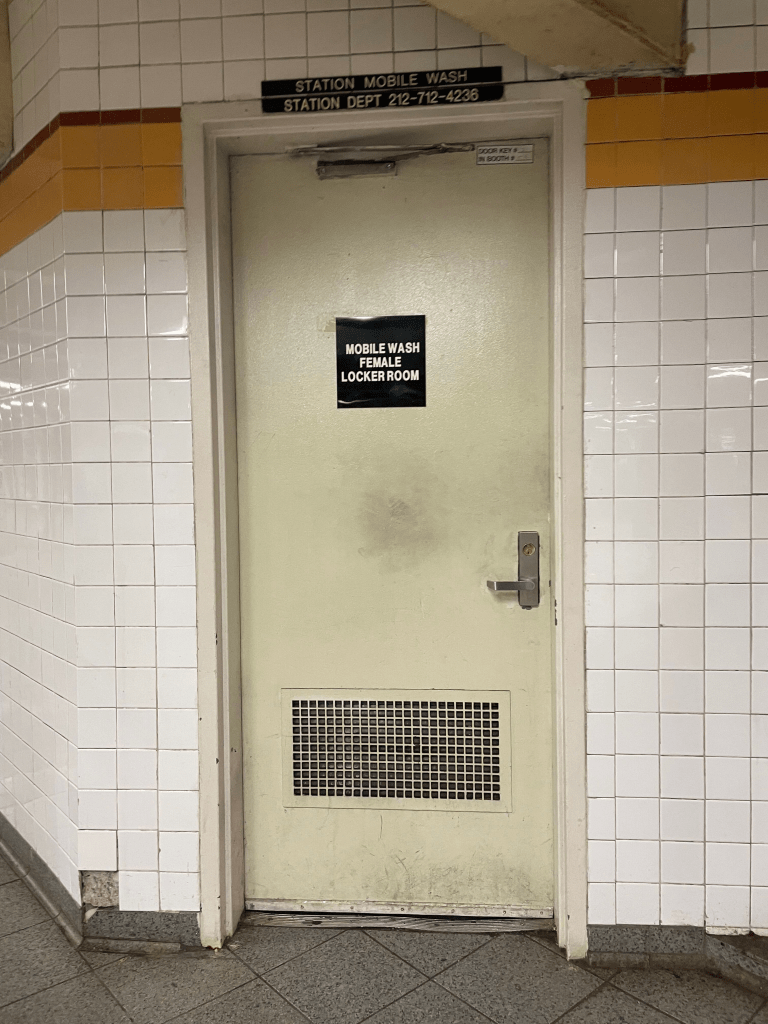
Mobile Wash. 14 St/8 Av Station. November 3, 2023
Vent & Drain. 3 Av Station. January 2, 2024
Manhole
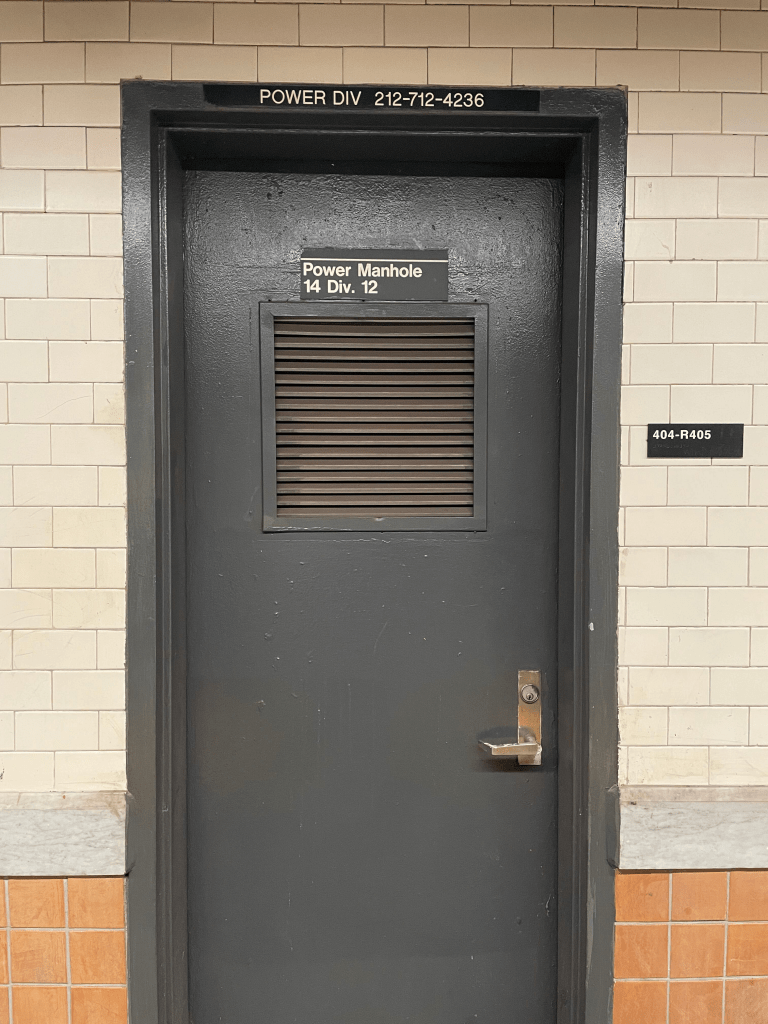
Power Manhole. 28 St Station. November 22, 2023
Cable Manhole. 14 St-Union Square Station. January 18, 2024
Manhole Room. 3 Av Station. February 14, 2023
Cable Mnhle. Lexington Av-59 St. November 22, 2023
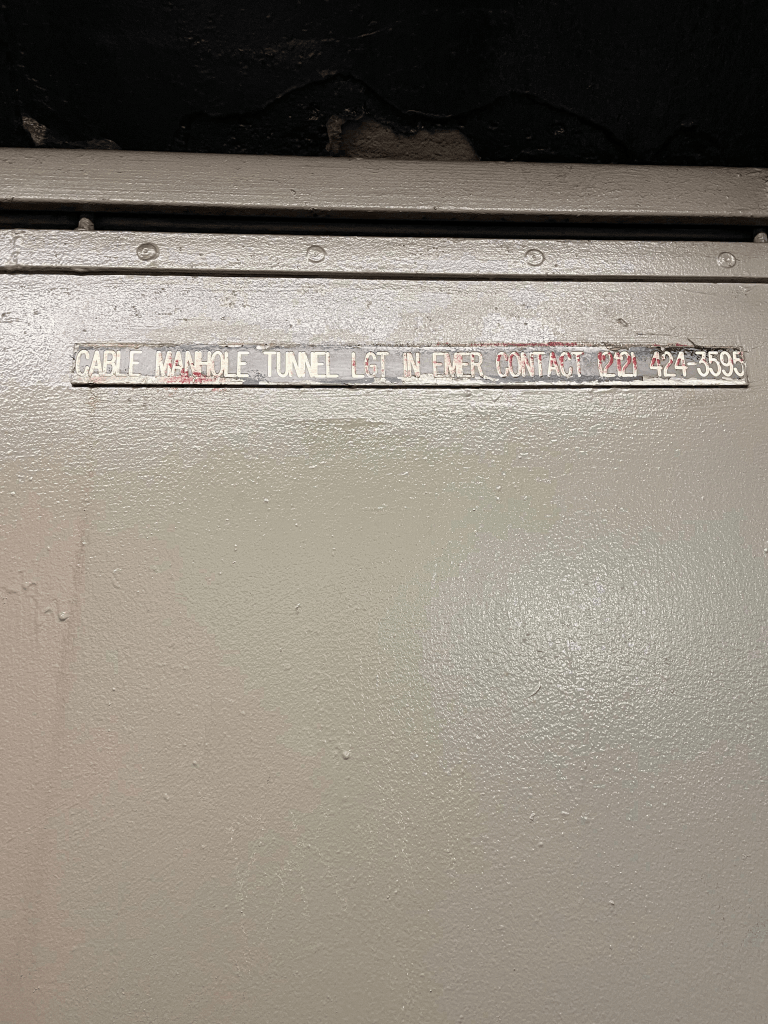
Cable Manhole Tunnel Lgt in Emer. Prince St Station. December 30, 2023
Almost door
Station Dept. 14 St/6 Av Station. January 19, 2024
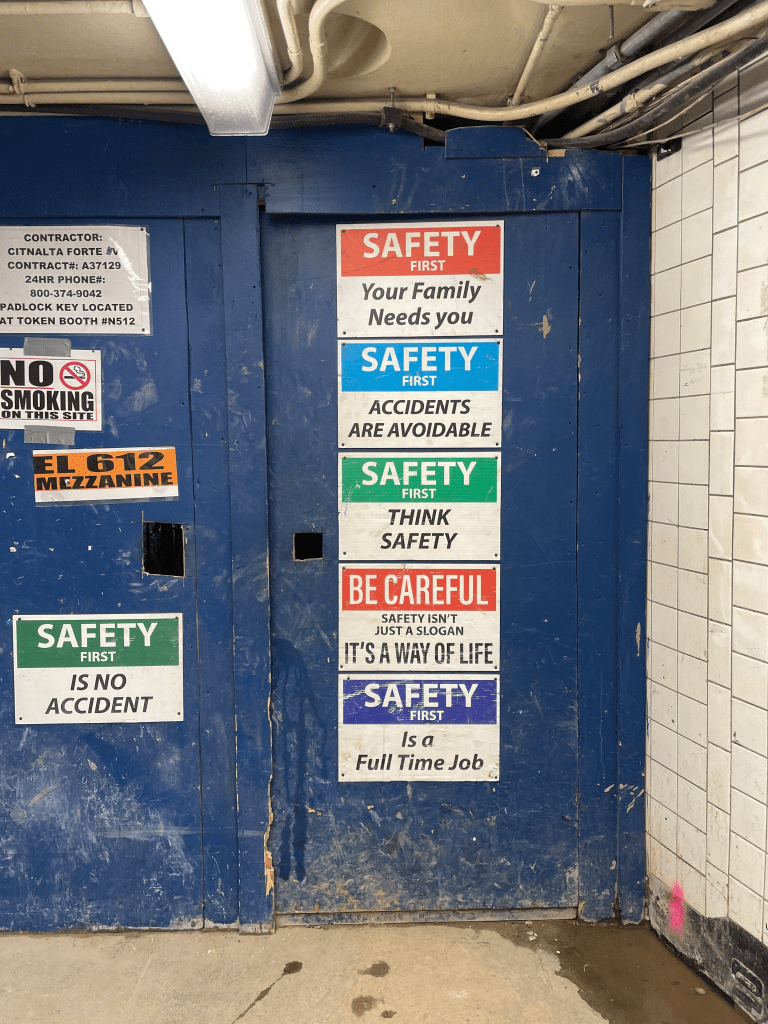
Your Family Needs You. 14 St/6 Av Station. February 29, 2024
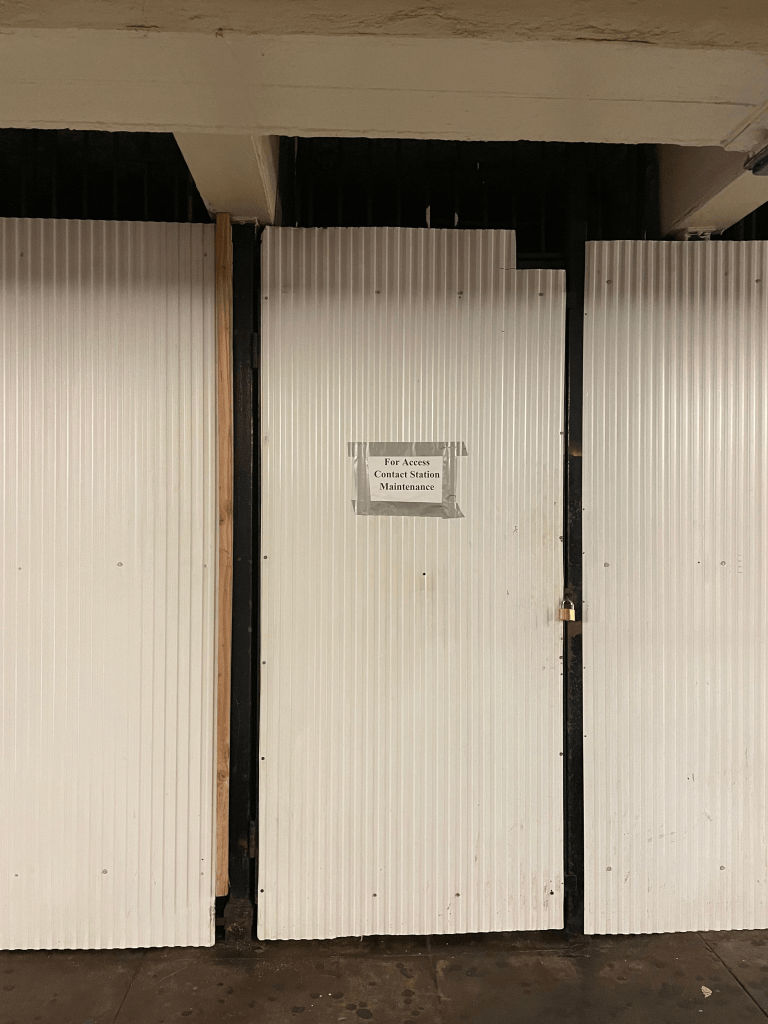
For Access. 168 St Station. February 28, 2023
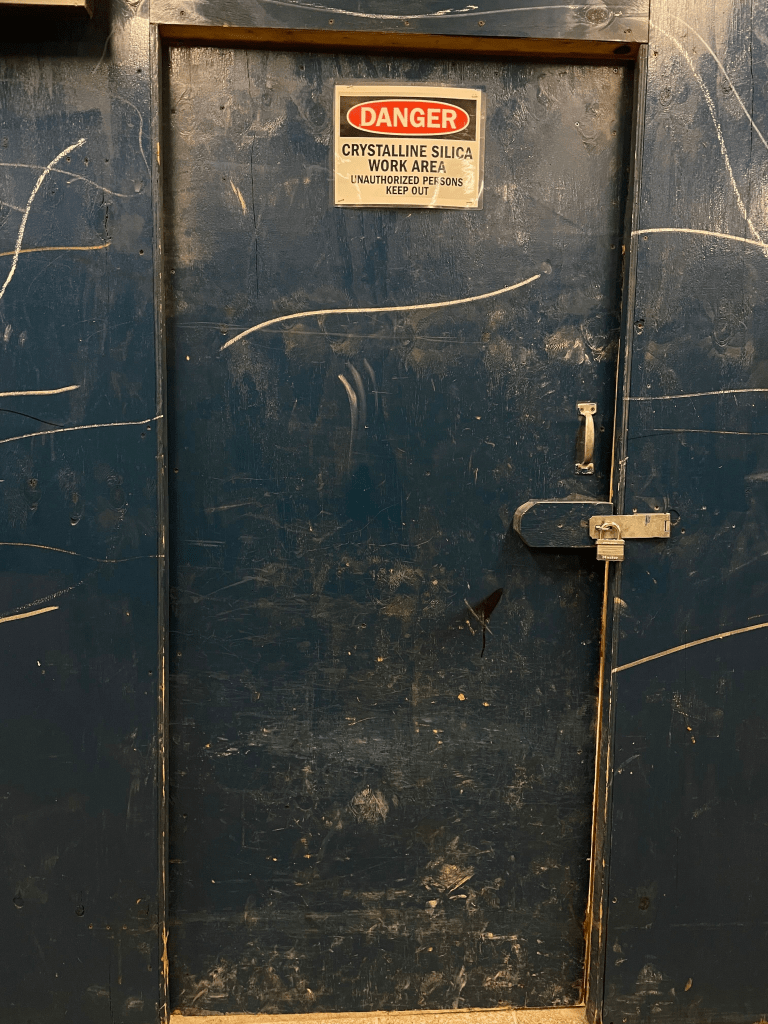
Crystalline Silica. Lorimer St Station. February 29, 2024
Epilogue
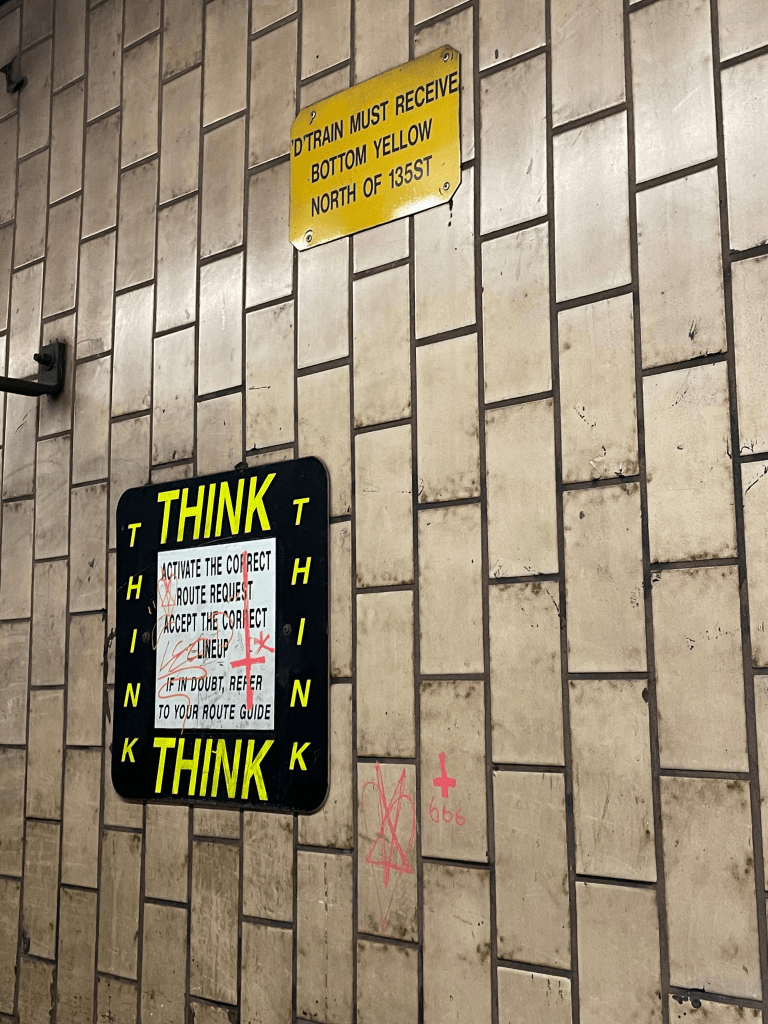
Think. 125 St Station. February 13, 2023
Manhole #127. Montrose Av Station. November 3, 2023.
I’m a patriot with no head I’m a head on a spike And I lost my man legs They’re in my big truck I want a baby I want a bloodline a life of service To cloak a life of despair
Jam on the brakes And let me hear myself think Let the babies out Let the blood. I want peace Meaning silence I want my mom to calm down So I can leave home I want dark and I want light In the meantime I’ll take the dim middle
2/27
Locked in side of my horror with a cross word puzzle Slake my thirst and soothe my damaged mind. I am only moving so slowly and jagged because I want to get some sun this hot winter. I want to face the sun and there is much to smell in this land of battered senses. It works when there’s a lot going on it quiets the noise in the head.
6/19
Well I’d like to know a pleasant life. Bring me to the last straw and I will get there. Well Once it breaks, who knows. Maybe there is nothing, maybe there is a gate. I promise I will change either way. Please help me find my joy. I need to rest my ears
6/20
Thanks be to the man who speaks loud I need a compass you give me a fine compass some direction
I know where I am going, death, and that is not important right now you give me a way
Big voice you tell me how to get there you get me living better and the volume
Makes it urgent like there is a reason
9/19 gold plated
Insisting on happiness, we eat barbecue, whatever there is left, we consider how people act without mercy in the name of love. We spend the night in a big room, rented in blood, staring at gold. I will forgive this slight, but not before we set it beneath the magnifying glass. We take out its insides.
9/21 Maria Hernandez Park
My neighbor walks down the road With a mannequin bust His bags are packed For attention. He speaks softly To his woman It is casual That they are placeless. My lord hangs the sky On a coat hook His manic dogs Nip at its fringe. Everyone in his world Plays volleyball They smack the sun Where they can see it. This whole whistling day Reeks of night time The short dogs lap At the growing cold.
I am telling you what it is like to hold a sharp man. And sweat, cry, and pull a heavy box uphill. I give because I want people to think I am fast. When in fact I am so weak I can’t even think straight, my arms are so weak. I am telling you what it is like to expire because I am always showing you whatever wrong thing will make me glow wonderful in your eyes.
Never care to know more than anyone is willing to share with me. Never even ask. You can’t force it.
My uncle Mike was both the most arcane man I’ve ever known and the most open. He managed to love and be loved deeply while leaving nearly everything to the imagination. He knew his life’s intrigue and he didn’t hide. He answered when you asked. He had a way of leaving you with a different question.
I didn’t get much time with him. While I didn’t know him so long, I don’t think anyone did. Not Dad not anyone. Like any good friend he could never leave for sure. He just disappeared at once and then slowly. He let us prepare to lose him.
He died around Labor Day I suppose. The air here was heavy and hot with decay. He died in India and they sent his body over to my grandparents choking down the last fumes of summer. That time of year the corn is cut and all the neighbors go home, empty empty expanse. The haze settles there where they bring in the dock, where you must wade into the lake now which cools before the new season. Where they plan another funeral for another child.
It was my first week of university. All the merriment downstairs tasted premonitory. Dad called on a Friday and we decided I wouldn’t come down for the service. It wasn’t far, right between school and home, but I had just gotten dropped off. None of that seems important now, but at the time no correct way presented itself. I wrote a poem to him in a book I never used again. Maybe I went out that night for some awful premeditated fun. I had made a good friend by then. I told her about what was going on. As much as you can three days into knowing someone and before you have the words. My uncle was buried, I got sick, and my parents and I tried not to send any news.
It was anticlimactic. He had lived an amazing life and then he receded from all that. It didn’t bother me that the proceedings were muted or that we were grieving in a disjointed way. I was mad I couldn’t find the words. The anger felt useless in my little room. I was mourning what I could not know. I’d never wanted to make him speak, but I thought he should have had the chance.
The frustration abated. I understood the confines of my control and it loosened. The sorrow had started long before. It happened as it happened, slow. I remembered an impassioned email I sent him when I was 10. I wanted to write a movie with him and he was far away. I had seen the Oscars and felt inspired. He had been there once and I missed him. It was a petition to return and stay delivered with a confidence I rarely trotted out. I was embarrassed by what I’d written. His reply was heartening but it could not shrink the distance. His visits became more infrequent, his behavior more erratic, and there was the illness. But I looked forward to them because of the laughter.
The people he left know how to grieve together. We’ve had a lot of practice. We do it best laughing and that’s how we sent him out into the lake in a lantern. He was there like we asked. It was the middle of another summer, where the days burn orange and the nights get cold. The corn isn’t ready and we push each other into the muddy field. I’m finding the words all the time.

























 madeleinejennings.com